The 9 Best AI Tools for PR in 2026
Every PR platform calls itself "AI-powered" in 2026. The label has become meaningless. Some tools use AI agents that run entire workflows end to end -- building media lists, scoring journalist fit, verifying contacts. Others bolted a ChatGPT wrapper onto a database that hasn't changed since 2019.
The difference matters because it determines how much time you actually save. A tool that generates a press release draft saves you twenty minutes. A tool that reads your press release, finds twenty journalists who covered the exact same topic last month, scores each one, and hands you a ready-to-send list saves you a day.
We tested every major PR tool on the market and ranked them by one question: how much of the real work does the AI actually do?
1. Medialyst
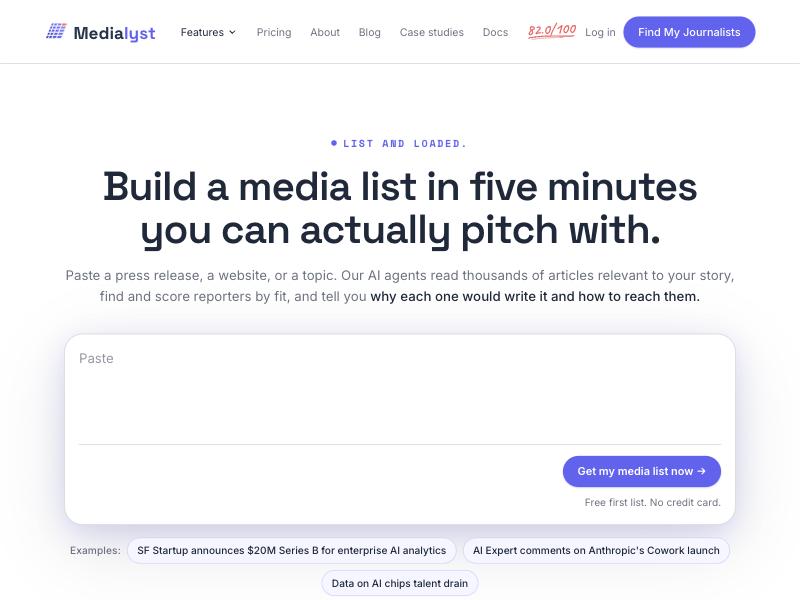
Medialyst is the only tool on this list that was built from scratch as an AI-native platform. There is no legacy database underneath. Instead, you paste a press release, a headline, or even a rough topic description, and Medialyst's AI agents go to work: they read thousands of recent articles to find journalists who are actively covering that exact beat, score each one on a 0-100 fit scale, and show you the evidence (the specific articles that prove the match).
The result is a media list you can actually pitch with, not a keyword-matched dump of names. Every contact is verified in real time, and the platform tracks opens, clicks, and replies with bot filtering so your analytics reflect real engagement.
What the AI does: Runs the full journalist-discovery workflow autonomously. You describe your story; it returns a vetted, scored, ready-to-pitch list.
Pricing: $149 to $800/month, no per-seat fees. First list is free.
Best for: Agencies and in-house teams that want accurate media lists fast without spending hours on manual research.
Website: medialyst.ai
2. Muck Rack
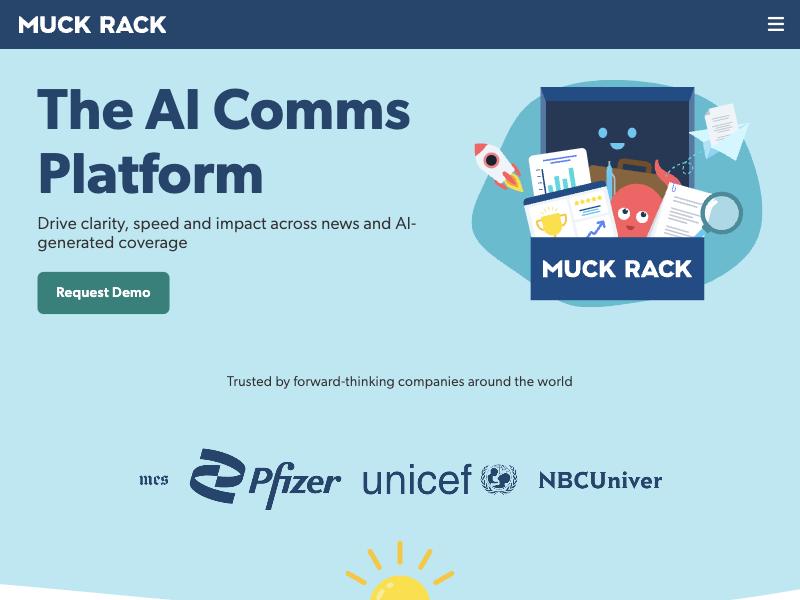
Muck Rack is the most widely adopted PR platform among large communications teams, and it has been adding AI features aggressively. Its core strength is still the journalist database and pitch-tracking CRM, but the AI additions are worth paying attention to: Generative Pulse tracks how your brand appears in AI-generated answers (not just traditional search), Muck Rack Agent automates repetitive workflow tasks, and the AI-powered journalist recommendations suggest reporters based on your pitch content.
The trade-off is complexity. Muck Rack does monitoring, reporting, database search, pitching, and analytics all in one platform. That breadth means a steeper learning curve and a higher price tag than single-purpose tools.
What the AI does: Assists with journalist discovery and recommends reporters. Monitors AI-generated brand mentions. Automates some workflow steps.
Pricing: Custom pricing via demo. Enterprise-oriented.
Best for: Large in-house communications teams that want one platform for everything and have the budget for it.
Website: muckrack.com
3. Meltwater
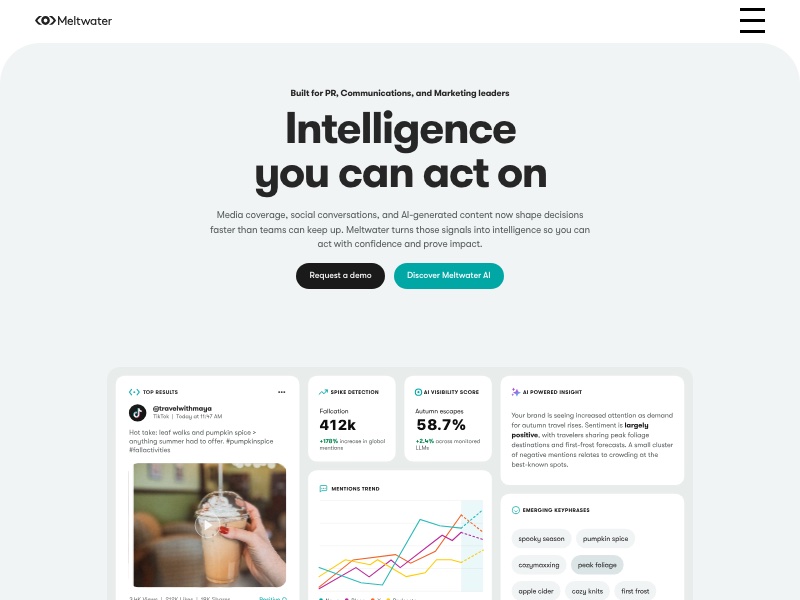
Meltwater processes over 1.3 billion documents daily across more than 240 languages, which makes it the most comprehensive media monitoring tool on the market by sheer volume. Its AI features lean toward intelligence and analysis rather than outreach: narrative detection surfaces emerging storylines, sentiment analysis flags shifts before they become crises, and auto-generated executive summaries save time on reporting.
The GenAI Lens feature tracks how AI platforms like ChatGPT and Perplexity portray your brand, which is increasingly important as consumers get answers from AI instead of search engines. If your primary need is knowing what is being said about you everywhere, Meltwater covers more ground than anything else.
What the AI does: Detects narratives and sentiment shifts across global media. Generates executive summaries. Tracks brand portrayal in AI-generated answers.
Pricing: Enterprise pricing, not publicly listed.
Best for: Global brands and enterprise teams that need monitoring across dozens of markets and languages.
Website: meltwater.com
4. Prowly (Semrush AI PR Toolkit)
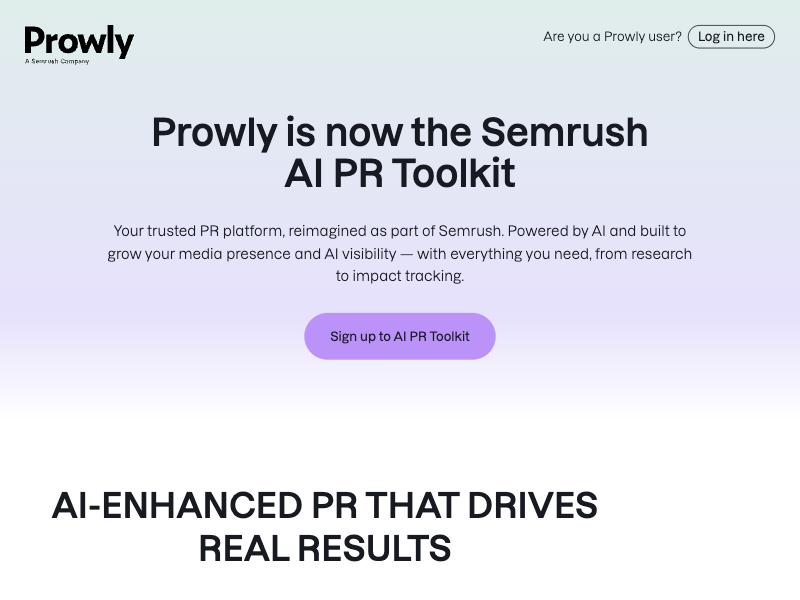
Prowly recently rebranded as the Semrush AI PR Toolkit, which tells you its angle: it sits at the intersection of SEO and PR. The platform combines a media database, email outreach, media monitoring, and an online newsroom builder. The Semrush integration means you can see which journalists and outlets are driving organic search traffic, not just coverage.
Its newer AI features include press release and outreach email drafting, real-time monitoring with AI-generated summaries, and an "AI-Cited Media Database" that shows which outlets influence AI models like ChatGPT and Gemini. That last feature is genuinely useful if you're thinking about generative engine optimization alongside traditional media.
What the AI does: Drafts press releases and outreach emails. Identifies outlets that influence AI models. Generates monitoring summaries.
Pricing: Available through Semrush. Free trial offered.
Best for: Teams that want to combine PR outreach with SEO data in one platform.
Website: prowly.com
5. Signal AI
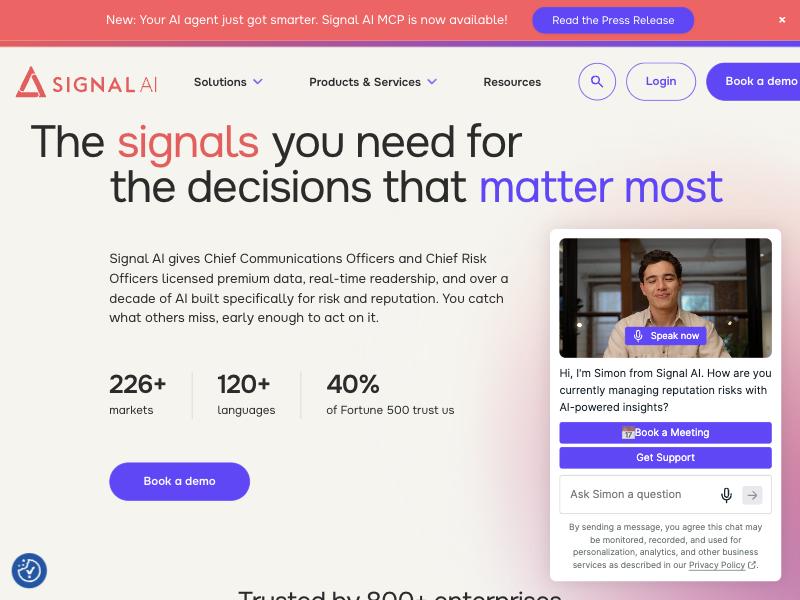
Signal AI is built for a different job than most tools on this list. It is a reputation and risk intelligence platform used by Chief Communications Officers and Chief Risk Officers at large enterprises. It processes 5.5 million articles daily across 226 markets and applies over a decade of purpose-built AI to risk scoring, entity labeling, and horizon scanning (detecting weak signals before they become full-blown issues).
Signal AI recently launched an MCP Connector, which means it can feed its intelligence data directly into AI assistants like Claude. It also has a Microsoft 365 Copilot integration. These are early but meaningful signals that the platform is thinking about how AI agents will consume its data, not just how humans will.
What the AI does: Scores risk by frequency and impact. Labels entities across 100+ million entities per day. Detects weak signals and emerging issues. Feeds data to AI agents via MCP.
Pricing: Enterprise pricing, not publicly listed.
Best for: Fortune 500 communications and risk teams that need early warning systems and reputation intelligence at scale.
Website: signal-ai.com
6. Cision
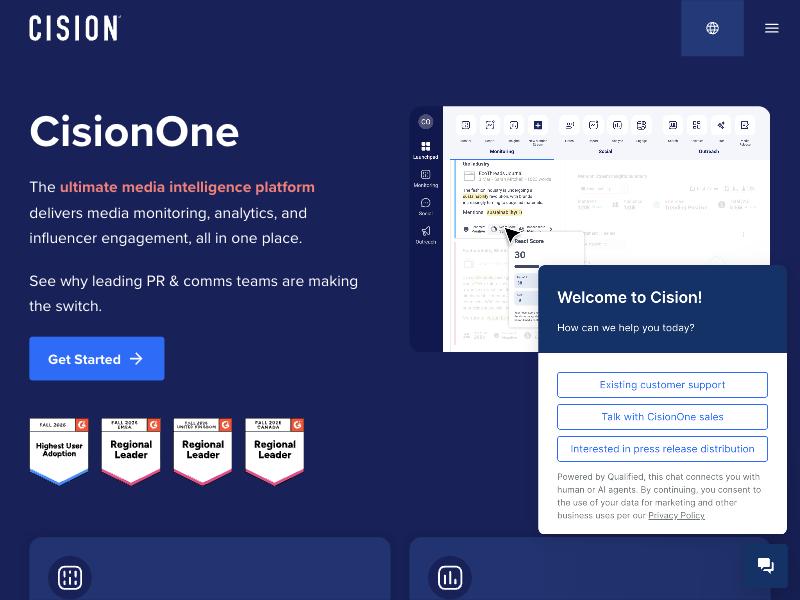
Cision is the incumbent. It owns the largest media database, runs PR Newswire (still the dominant wire distribution service), and provides monitoring and analytics through CisionOne. The AI additions are catching up: CisionOne AI enhances analytics with smarter filtering and trend detection, and the AI Visibility product tracks how your brand appears in generative AI outputs.
Cision also acquired Trajaan for search intelligence, adding another layer of data. The platform's main advantage is its infrastructure: if you need wire distribution, a massive contact database, and monitoring in one contract, Cision is the only vendor that bundles all three. Its main disadvantage is that it feels like a legacy platform with AI features attached rather than an AI-native tool.
What the AI does: Enhances analytics and filtering. Tracks AI visibility. Acquired search intelligence via Trajaan.
Pricing: Enterprise pricing, not publicly listed.
Best for: Teams that rely on wire distribution and need the broadest media contact database available.
Website: cision.com
7. Onclusive
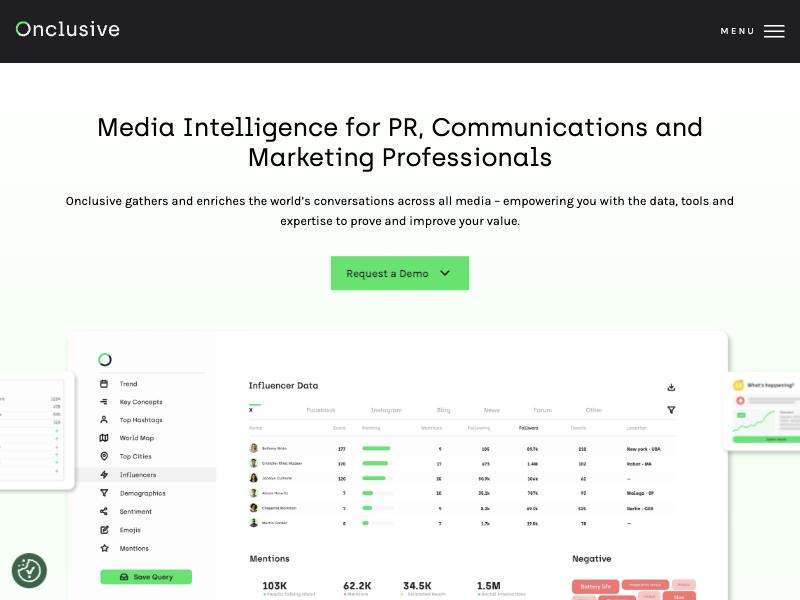
Onclusive merged with Critical Mention to create a unified platform covering media monitoring, measurement, and management. The standout 2026 feature is GEO Analytics, which tracks how ChatGPT, Gemini, Grok, Claude, and Perplexity describe your brand. It includes anomaly detection and share-of-voice benchmarking across AI engines, which makes it one of the most focused tools for understanding your brand's position in the generative AI landscape.
This is a tool for measurement and intelligence, not outreach. If you are trying to answer "how do AI models talk about us?" with real data rather than guesses, Onclusive's GEO Analytics is the most direct answer on the market.
What the AI does: Tracks brand mentions across five major AI engines. Benchmarks share of voice in AI-generated answers. Detects anomalies in AI brand portrayal.
Pricing: Enterprise pricing, not publicly listed.
Best for: Communications teams focused on measuring AI visibility and proving PR impact with data.
Website: onclusive.com
8. Agility PR Solutions
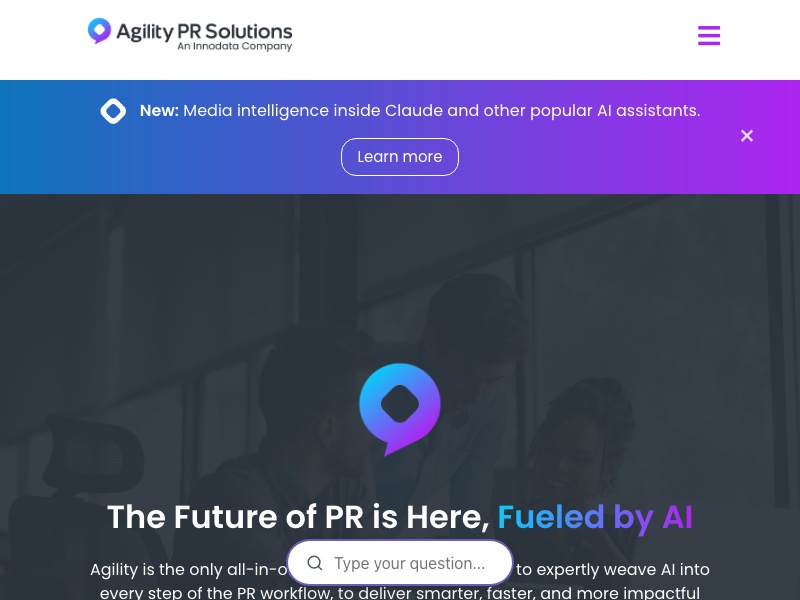
Agility PR Solutions positions itself as an all-in-one PR platform with AI woven into every step. Its PR CoPilot AI suite generates press releases and outreach emails, matches journalists using AI, runs sentiment analysis, monitors social channels in real time, and produces AI-enhanced executive briefings. Agility also launched an MCP Connector, which brings its media intelligence data into AI assistants.
The platform serves a wide range of clients, from mid-market to enterprise (Comcast, McDonald's, and Porsche are listed as customers). The MCP connector is notable because it means Agility's data can plug directly into the agentic workflows that are becoming standard for modern PR teams.
What the AI does: Generates press releases and outreach emails. Matches journalists by AI. Provides sentiment analysis, social monitoring, and executive briefings. Feeds data to AI agents via MCP.
Pricing: Custom pricing via demo.
Best for: Mid-market to enterprise teams looking for an all-in-one platform with strong AI writing and monitoring features.
Website: agilitypr.com
9. Prezly
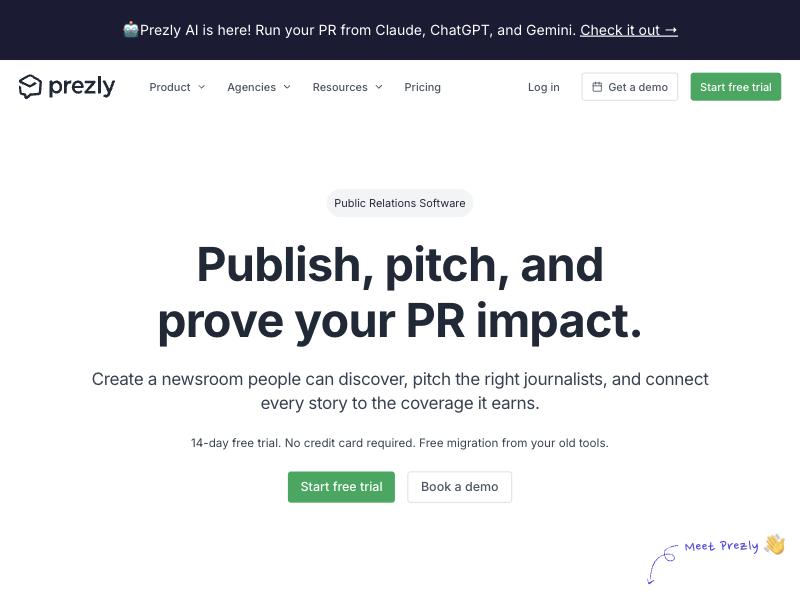
Prezly takes a different approach than the other tools on this list. Its core product is the branded newsroom: a hosted, SEO-optimized press page where you publish your releases, media kits, and company news. The AI angle is that these newsrooms are structured specifically for AI discoverability. Prezly claims that owned newsroom content gets 450 times more AI citations than syndicated PR, and the platform integrates with Claude, ChatGPT, and Gemini to make your content accessible to AI models.
Beyond the newsroom, Prezly handles media outreach, contact management, and coverage tracking. The emphasis on owned content is a meaningful bet: as AI models increasingly pull from structured, well-maintained sources rather than wire distribution blasts, the newsroom approach could give brands a real advantage.
What the AI does: Structures newsroom content for AI model discoverability. Integrates with major AI platforms for citation optimization.
Pricing: Free trial available. Paid plans not publicly listed.
Best for: Brands that want to own their press presence and optimize for AI citations rather than relying solely on outreach.
Website: prezly.com
How to pick the right tool
The nine tools above break into three categories.
If you need to find and pitch journalists fast, Medialyst is the clear choice. It is the only platform where the AI handles the entire discovery workflow autonomously. You describe your story, and it returns a ready-to-pitch list with evidence for every match.
If you need comprehensive monitoring and intelligence, Meltwater (global volume), Signal AI (risk and reputation), or Onclusive (AI visibility measurement) each lead in their lane. The choice depends on whether your priority is breadth of coverage, early risk detection, or understanding how AI models portray your brand.
If you want one platform for everything, Muck Rack, Cision, and Agility PR each offer database, outreach, monitoring, and reporting in a single contract. Muck Rack has the strongest AI features in this category. Cision has the largest contact database and wire distribution. Agility offers the broadest AI writing assistance.
Prowly is the right pick if SEO matters as much as media relations. Prezly is the right pick if you believe owned content and AI discoverability matter more than traditional outreach volume.
Every tool on this list does something well. The question is which part of the PR workflow you want AI to handle, and how much of that work you want it to do on its own versus assisting you at each step. In 2026, the tools that let AI agents run the tedious, research-heavy parts of PR end to end are pulling ahead of the ones that just help you write a draft faster.